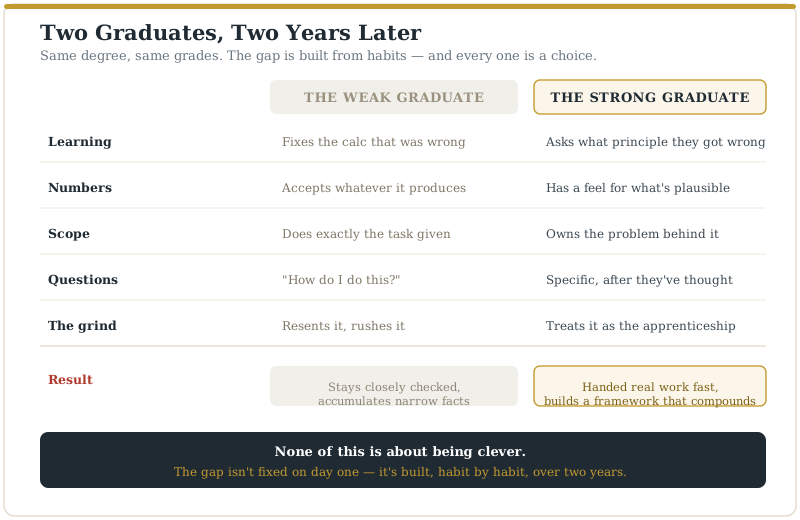
Two graduates start on the same day, with similar degrees and similar grades. Two years later one is being handed real responsibility and the other is still being closely checked on everything. The gap that opened between them almost never came down to intelligence or what they knew on day one. It came down to a handful of habits — and they're learnable, which is the point of writing them down.
If you're early in your career, this is what the people a few years ahead are quietly noticing about you.
They build judgement, not just answers
The weak graduate wants the answer. The strong one wants to understand why it's the answer. Same task, completely different trajectory — because the first is accumulating completed tasks and the second is accumulating judgement.
When a senior engineer corrects a calc, the weak graduate fixes that calc. The strong graduate asks what general principle they got wrong, so the whole class of error disappears rather than the single instance. Over two years, one has done a hundred tasks and learned a hundred narrow facts; the other has done a hundred tasks and built a framework. The second compounds. The first doesn't.
They develop a feel for numbers
The single most valuable early-career instinct is the ability to look at a result and sense whether it's plausible. A beam size that feels too small, a reaction that doesn't look like it sums, a deflection that's an order of magnitude off. The strong graduate builds this fast, because they pay attention to magnitudes and ask "does that look right?" before moving on.
The weak graduate accepts whatever the calculation or the model produces, because they have no independent expectation to check it against. This is the difference between an engineer and a calculator operator, and it shows up within months. The way to build it is almost embarrassingly simple: estimate the answer before you compute it, every time, and notice when you're wrong.
They own the problem, not just the task
Give a weak graduate a task and they do exactly that task. Give a strong one the same task and they understand where it sits — what it feeds into, what happens if it's wrong, why it was asked for. They flag the thing you didn't ask about but should have. They notice the input that looks off rather than dutifully designing to it.
This is the shift from "doing what I was told" to "understanding what we're trying to achieve," and it's the single biggest thing that earns trust. The engineer who only does precisely what's asked has to be told everything. The one who grasps the intent can be given a goal and trusted to get there — which is the whole basis of being handed responsibility.
They ask good questions — and time them well
There's an art to questions that the strong graduate works out quickly. Ask too few and you guess, get it wrong, and waste a senior's time on rework. Ask too many, without thinking first, and you signal you can't make progress alone. The strong graduate hits the middle: they attempt the problem, get as far as their judgement allows, and then ask a specific, well-formed question about the actual sticking point.
"How do I do this?" is a weak question. "I've assumed X because of Y, which gives me Z, but I'm not sure the assumption holds at the transfer level — can you sanity-check my reasoning?" is a strong one. The second shows thinking and gets a useful answer. Question quality, more than question quantity, is what seniors use to gauge how much rope to give someone.
They do the unglamorous work properly
A lot of early-career work is repetitive and feels beneath the degree — checking drawings, taking off quantities, running variations of the same calc. The weak graduate resents this and does it carelessly, treating it as a tax to be paid before the interesting work begins. The strong graduate understands that the repetition is the apprenticeship — that the hundredth load take-down is what wires the judgement to spot a bad one instantly.
The grind is where the pattern library gets built. The graduate who does it properly is investing; the one who rushes through it is skipping the very reps that make the senior years possible. It's not a detour around the interesting work. It's the path to being trusted with it.
What this means in practice
None of these are about being clever. They're about how you approach the work: chase the principle behind the correction, build an independent feel for whether a number is right, understand the intent and not just the instruction, ask sharp questions after you've thought, and treat the boring reps as the training they are.
A graduate who does these things becomes someone seniors want to hand real work to, fast — not because they already know more, but because the way they learn means they can be trusted to. A graduate who doesn't stays in close-checked work far longer, regardless of how good their grades were.
The encouraging part is that every one of these is a choice, not a talent. The gap between the strong and the weak graduate isn't fixed on day one. It's built, habit by habit, over the two years that decide how the rest of the career starts.