There's a comfortable assumption that when the building is finished, the certificate is issued, and the team moves on, the job is closed. The drawings are stamped, the client is happy, the file goes to archive. Psychologically, the work is over. Legally and professionally, it is not, and the gap between those two facts is where engineers occasionally get a nasty surprise years later.
A structure has a long life, and the engineer's connection to it doesn't end the day the scaffolding comes down.
Handover is a milestone, not an ending
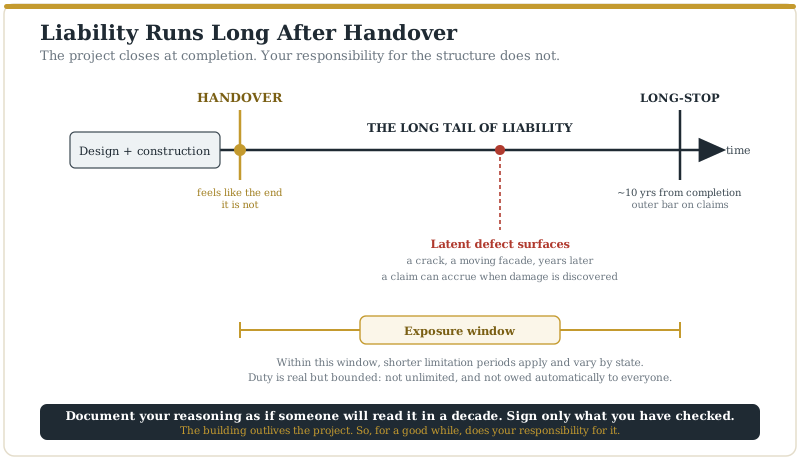
Practical completion feels like a finish line, and in project terms it is. But a defect in the engineering doesn't care that the project closed. It sits in the structure, latent, and can surface years later, when a crack opens in a slab, when a facade starts to move, when something quietly wrong from the start finally shows itself.
Australian law recognises this directly. A long-stop period, broadly in the order of ten years from completion, sets an outer boundary beyond which claims are generally barred, and that alone tells you the exposure runs long after the ribbon is cut. Within that window shorter limitation periods apply and vary by state, but the point for an engineer is conceptual: a cause of action for a latent defect can accrue when the damage appears or is discovered, which may be years after the work was done. The clock doesn't simply run from handover and stop.
The practical translation is that a design decision made today can be examined, in forensic detail, most of a decade from now, by people who weren't in the room and who have the benefit of hindsight.
Real, but not unlimited
It's easy to swing the other way and imagine limitless, permanent exposure to anyone who ever touches the building. That's not the picture either, and the honest version matters.
Duty of care in the Australian context is real but bounded: in time by the limitation and long-stop periods, and in scope by who is actually owed the duty. That second question is genuinely contested. The High Court's decision in Woolcock Street Investments is the cautionary example the other way, engineers who designed a warehouse's foundations were found not to owe a duty of care to a subsequent commercial owner who later found defects. Duty to downstream parties, particularly for commercial buildings, is not automatic. More recent statutory developments push the other way in some states, with duties that reach designers, extend to subsequent owners, and sometimes can't be delegated or contracted out of.
The detail is state-specific and evolving. The point isn't to know every limitation period by heart. It's to hold the correct mental model: your responsibility for a design has a long tail, its boundaries are real but contested, and "the project closed" is not the answer to any of it.
Why this matters more in an AI-drafted world
Here an old principle meets a new pressure. AI can now produce a calculation, a report, a design justification, faster and more fluently than ever, and the temptation is to accept the polished output and move on because it looks complete and the project is in a hurry.
But the liability model hasn't changed at all. The engineer who signs is still the one accountable, and that accountability still runs for the long tail. If an AI-drafted calculation carries a wrong assumption that surfaces as a defect eight years from now, "the tool produced it" is not a defence, and the tool won't be the one explaining itself in a forensic investigation. You will.
So the persistence of liability is exactly the reason not to let AI erode the verification discipline. The faster the drafting becomes, the more it matters that a competent engineer has genuinely understood and checked what they're putting their name to, because they carry it forward through the whole life of the structure.
What this means in practice
Treat handover as a milestone, not the end of your responsibility. A design decision made now has a long tail of potential scrutiny, bounded by real but state-specific limits, so don't assume you're free the day the project closes, or liable forever to everyone. Two habits follow directly. Document your reasoning as though someone will read it in a decade, because they might, and the record is the thing that speaks for you once memory is gone. And sign only what you've genuinely checked and understood, because anything you certify, you're standing behind for the long tail, not just until the invoice is paid. As AI makes the drafting faster, hold that verification standard higher, not lower.
The building will outlive the project. So, for a good while, will your responsibility for it.
This is general professional-practice commentary, not legal advice. Limitation periods, duties of care, and statutory obligations vary significantly by state and project and change over time. For any actual question about liability, consult a qualified construction lawyer.