There's an old career instinct in engineering that says breadth is safety. Know a bit of everything, stay flexible, don't get pigeonholed, and you'll always have work. It made sense for a long time. It makes less sense every year, and the engineers who are quietly pulling ahead now are doing the opposite: going deliberately, unfashionably narrow.
This isn't a coincidence, and it isn't a limitation. It's a strategy, and it's the right one for the moment we're in.
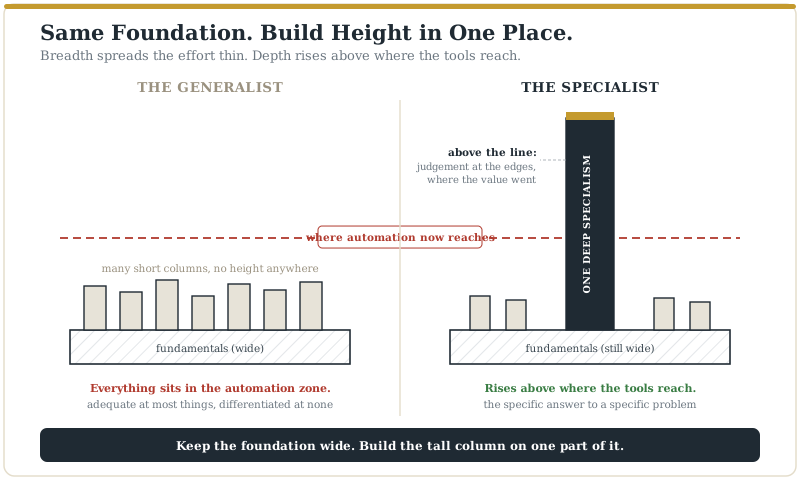
Breadth is the most exposed position there is
Think about what broad, general competence actually is. It's the ability to do a reasonable job across a wide range of ordinary problems. That was valuable when the ordinary problems needed a person to do them. Increasingly they don't, or they need far less of a person than they used to.
Look at what the generalist's working day is mostly made of:
- The routine calculation for a familiar situation
- The standard detail, adjusted slightly for this project
- The clause lookup and the load combination assembly
- The first-pass design across a dozen well-trodden cases
That's the well-documented, pattern-shaped middle of the profession, and it's exactly what capable general-purpose tools are getting good at. So the generalist is standing precisely where the automation is arriving. Broad competence isn't a hedge against AI. It's the thing AI most directly replicates.
Depth is where the judgement lives
Now think about what deep specialism is. It's not knowing more facts about one topic. It's having the judgement that only comes from working the edges of a discipline for years, the part where the textbook answers run out and experience takes over.
The specialist in post-tensioned transfer structures, or tall-building lateral behaviour, or seismic detailing, knows things that aren't written down anywhere:
- Which assumptions break, and under what conditions
- What the model quietly gets wrong for this class of structure
- Where the real risk actually sits, as opposed to where the code check looks
- What a bad answer smells like before the calculation confirms it
That is judgement at the boundary, and it's the hardest thing to replicate, precisely because it isn't documented and can't be reduced to a pattern. It's also where the value is. Nobody hires a specialist for the ordinary problem; they hire them for the one the generalist can't confidently handle. Depth is defensible in a way breadth simply isn't, because the value sits in the part of the discipline that tools reach last.
The narrow engineer is the one people come to
There's a practical side to this beyond the AI argument. When a project has a genuinely hard problem in a particular area, the people running it don't want someone who can do a bit of everything. They want the person known for exactly that thing. Being narrow and known for it turns you from one interchangeable resource into the specific answer to a specific problem, and that's a completely different market position.
It also compounds. Every hard problem you solve in your specialism deepens the judgement and sharpens the reputation, which brings the next hard problem, which deepens it further. Breadth spreads that effort thin across areas that never get deep enough to compound. Depth concentrates it until you're the obvious choice.
Narrow doesn't mean ignorant
To be clear about what this isn't. Going narrow doesn't mean losing the fundamentals or refusing to understand anything outside your lane. A good specialist keeps a strong first-principles grounding across the whole discipline, load paths, behaviour, the core physics, because that's what lets them see how their area connects to everything else.
The narrowing is in where you invest the judgement-building years. You keep the wide foundation and build the tall column on one part of it. What you stop doing is trying to build a tall column everywhere at once, which produces a lot of short columns and no height anywhere.
What this means in practice
The two positions, side by side:
| The generalist | The specialist |
|---|---|
| Does most things adequately | Does one thing at a level not easily replicated |
| Stands where automation is arriving | Works the edges automation reaches last |
| One interchangeable resource | The specific answer to a specific problem |
| Effort spread thin, never compounds | Effort concentrated, compounds into reputation |
If you're early or mid-career, resist the instinct that breadth is safety. It was, once. Now it puts you exactly where the tools are landing. Pick something that matters, that's genuinely hard, and that you can go deep on for years, then go deep. Keep the fundamentals wide but concentrate the real investment.
The best engineers are getting narrower on purpose. Not because they can't do more, but because they've noticed where the value went, and it went to the edges, not the middle.