A new kind of reputation is forming in some engineering offices. There's the person who has become very good at getting AI tools to produce things: the slick prompt, the fast first draft, the calculation or report that appears in minutes. They look productive, they look modern, and in a hurry they look like the future. Increasingly, being good at prompting is treated as a skill worth having in its own right.
It's worth being clear-eyed about this, because prompt fluency and engineering competence are not the same thing, and confusing them is a trap that catches offices and individuals alike.
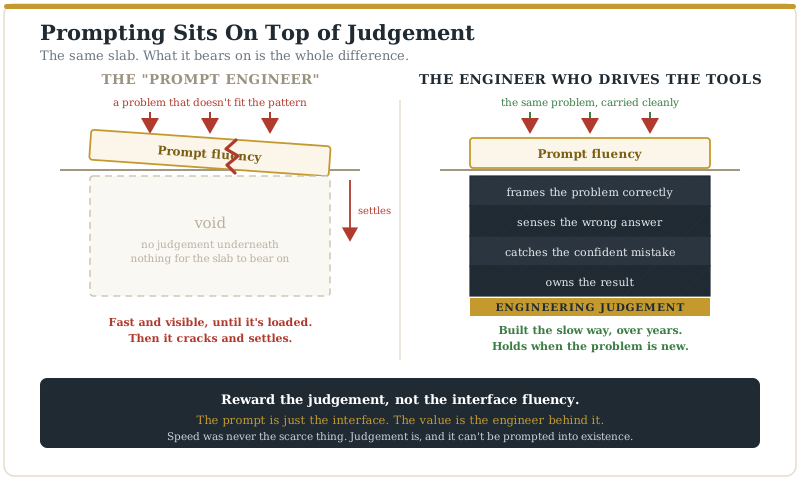
Prompting is a skill. It's just not the skill.
Getting good output from an AI tool is a genuine ability. Knowing how to frame a request, give the right context, and iterate toward something useful has real value, and dismissing it entirely would be as wrong as overrating it. The tools are here and using them well beats using them badly.
But it sits on top of engineering judgement, not in place of it. A prompt that produces a plausible calculation is worth nothing if the person sending it can't tell whether the answer is right. The prompt is the easy part. The hard part, the part that took years to build, is the judgement to know what to ask for, whether the output is sound, and where it's quietly wrong. Prompt fluency without that judgement is a fast route to confident, well-formatted mistakes.
The trap for the individual
For a younger engineer especially, the trap is seductive. Becoming the office's go-to prompt person feels like getting ahead. You're fast, you're visible, you're producing more than the people grinding through things the slow way. It looks like a shortcut past the tedious early years.
It isn't. It's a shortcut past the exact years that build the judgement the whole career rests on. The engineer who spent two years prompting their way to fast output, without ever developing the internal sense of whether that output is right, has built a skill with a short shelf life on top of a foundation that isn't there. When the problem doesn't fit the pattern, when the AI is confidently wrong, when someone senior asks "why", the prompt fluency has nothing underneath it. Speed was never the scarce thing. Judgement is, and it can't be prompted into existence.
The trap for the office
Offices fall for a version of the same thing. It's tempting to look at the prompt-fluent, high-output people and see productivity, and to quietly value visible speed over the harder-to-see quality of judgement. That's a dangerous thing to reward, because it optimises for exactly the wrong trait.
An office that celebrates prompt output over engineering understanding is training its people to prioritise fast plausible results over correct ones, and hollowing out the judgement it depends on to catch errors. It also builds fragility: when the accountability question arrives, and in engineering it always does, "we generated it quickly" is not an answer anyone wants to be giving. The productivity is real but shallow. The risk it carries is real and deep.
What actually deserves the reputation
The engineer worth valuing in an AI office isn't the one with the slickest prompts. It's the one who uses the tools well and can stand behind everything that comes out of them: who frames the problem correctly, sense-checks the output ruthlessly, catches the confident wrong answer, and owns the result. That person uses AI as a genuine multiplier, because they're multiplying real judgement. The prompt is just the interface. The value is the engineer behind it.
That's the distinction offices and individuals both need to hold. Reward the judgement, not the interface fluency. Use the tools hard, but never mistake being good at the tools for being good at the engineering.
What this means in practice
Use AI, and get good at using it, because it's a real advantage. But don't build a reputation, or a career, on prompt fluency alone, and don't let your office reward it as though it were the main event. It's the surface. Underneath it, the thing that was always valuable and still is, is the judgement to know what to ask, whether the answer is right, and the willingness to own it.
The prompt engineer looks like the future. The engineer who can drive the tools and stand behind the result actually is one. They're not the same person, and knowing the difference is the whole point.