Here's an uncomfortable way to audit your own skills: list what you're good at, then ask how much of it AI will be able to do in three years. The honest answer for a lot of engineers is "more than I'd like." Drafting calcs, looking up clauses, assembling load combinations, writing the routine sections of a report — the work that's easy to describe is exactly the work that's easy to automate.
That's not a reason for alarm. It's a reason to be deliberate about where you invest the next few years. Because the same shift that commoditises the routine makes a different set of skills more valuable than they've ever been — and they're mostly not the ones engineers instinctively train.
This is the third in a short series on AI and structural engineering. The first argued AI won't make a graduate an engineer; the second, that it changes what we're paid for. This one is the practical answer to the obvious next question: so what do I actually build?
1. Knowing what to model — problem framing
AI can run any analysis you set up. What it can't do is decide which analysis the building needs. That this structure wants a semi-rigid diaphragm. That the transfer level governs. That the wind serviceability case is the one that'll bite. That the whole thing hinges on a load path nobody's drawn yet.
Problem framing is the highest-leverage skill in engineering and the least automatable, because it happens before there's a defined problem to hand to a tool. It's the judgement to look at a messy, ambiguous, real situation and decide what actually matters. Invest here and you become the person who points the tools at the right target — which is worth far more than being fast at running them.
2. Sense-checking — the smell for a wrong answer
Experienced engineers catch errors without re-deriving anything. A period that's too long for the building's height, a reaction that doesn't sum, a column too slender for its load — the wrongness registers before the calculation confirms it. That sense is pattern recognition built from hundreds of hours of doing the work by hand.
This skill gets more valuable as AI produces more output, not less. AI is fluent and confident regardless of whether it's right, which means the bottleneck shifts to the person who can look at a plausible, well-formatted answer and feel that something's off. The verifier has to be sharper than the producer ever did. If you can be the one who reliably catches the confident wrong answer, you're holding the skill the whole AI workflow depends on.
3. Depth in a genuine specialism
Broad, shallow competence is the most exposed position in the AI era — it's exactly what a capable general-purpose tool replicates. Deep expertise in a real specialism is the opposite: hard to acquire, hard to fake, and the thing people come to you for specifically.
Pick something that matters and go genuinely deep — post-tensioned design, high-rise lateral behaviour, seismic, the analysis behind a particular class of structure. Depth is defensible in a way breadth isn't, because the value is in the judgement at the edges of the discipline, where the textbook answers run out and experience takes over. That edge is precisely where AI is weakest and where a specialist is strongest.
4. Translating between the model and reality
A model is a set of assumptions. The skill that matters is knowing how well those assumptions match the building that'll actually get built — and where they don't. AI will get better at producing models. Knowing whether a model represents reality, what it quietly assumes, and where those assumptions break is human judgement built from seeing real structures, real construction, and real failures.
This is the skill that turns analysis into engineering. Anyone can get a number out of software. Knowing whether to believe it — whether the idealisation holds, whether the load path is real, whether the construction sequence the model ignores actually governs — is the part that doesn't transfer to a tool.
5. Using the tools well — including AI itself
None of this is an argument to avoid AI. The opposite: fluency with the tools, including AI, is itself a skill worth building. The engineers who'll pull ahead aren't the ones who refused to use AI or the ones who outsourced their thinking to it — they're the ones who learned to drive it hard while keeping their judgement in the loop.
That means knowing what to delegate and what to keep, how to check what comes back, and how to use automation to clear the routine 80% so your time goes to the 20% that needs an engineer. Pairing strong judgement with strong tools is a genuine multiplier. The skill is the pairing — neither the judgement nor the tool is worth as much alone.
What this means in practice
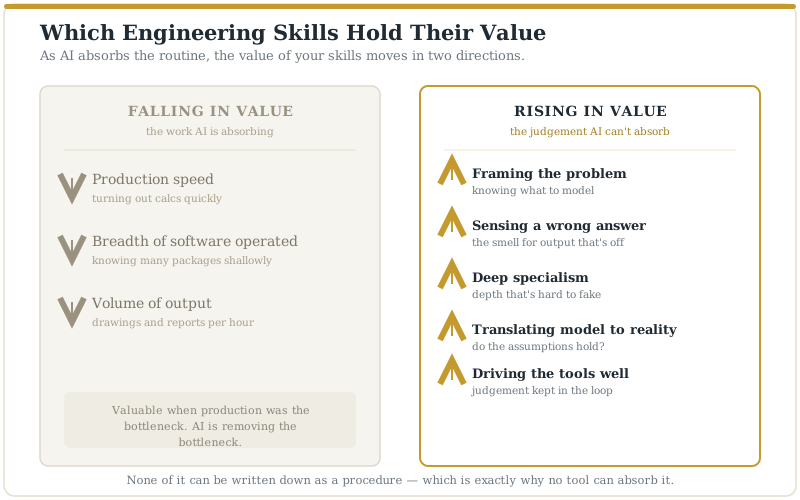
Notice what's not on this list: speed at producing calcs, breadth of software you can operate, volume of output. Those were valuable when production was the bottleneck. AI is removing that bottleneck, and their value is falling with it.
What's left — framing the problem, sensing the wrong answer, deep specialism, translating model to reality, and driving the tools without surrendering your judgement — has one thing in common: none of it can be written down as a procedure, which is exactly why no tool can absorb it. It's all judgement, and judgement is built the slow way, through doing the work and accumulating the pattern library that lets you see what a tool can't.
The engineers who thrive over the next decade won't be the ones who were fastest to adopt AI or the most resistant to it. They'll be the ones who got deliberate, early, about building the capabilities that get more valuable as the routine gets cheaper. The routine is getting cheaper fast. The judgement is the asset. Build the asset.