The most common reason a CPEng submission struggles isn't a thin career or weak projects. It's that the candidate wrote the wrong document. They described what they did — the project, the role, the outcome — when the assessment is asking something subtly but fundamentally different: demonstrate the competency you personally exercised. Those are not the same piece of writing, and the gap between them is where most applications lose ground.
If you're preparing a submission, this is the distinction worth internalising before you write a single competency claim.
What the assessment is actually structured around
Chartered assessment is built on the Stage 2 competency standard — sixteen elements grouped across a knowledge and skill base, engineering application ability, professional and personal attributes, and professional conduct. You evidence them through competency claims (each focused on a single element), an experience record, referees and a verifier, and for most pathways a professional interview.
The structure tells you what's being assessed: not your projects, but your competence demonstrated through your projects. The projects are evidence. The competency is the claim. Candidates routinely invert this — they make the project the subject and treat the competency as a label stuck on top.
The core gap: describing work vs demonstrating competency
Here is the failure in its purest form. A candidate writes:
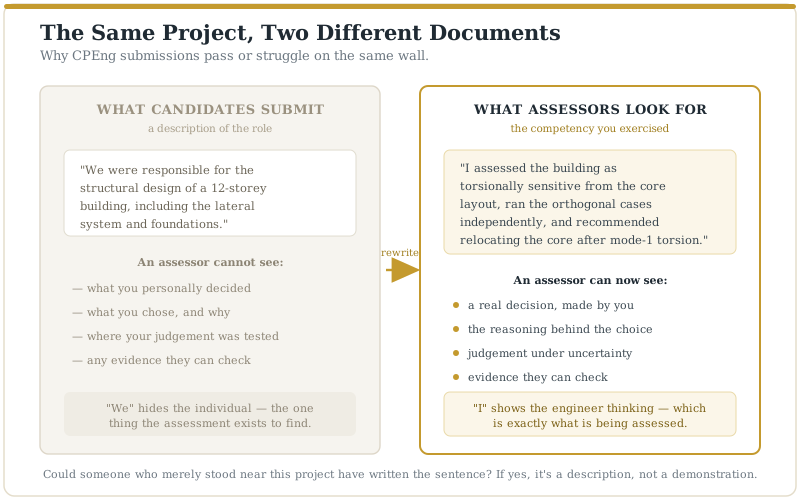
"I was responsible for the structural design of a twelve-storey building, including the lateral system and foundations."
That's a description of a role. It tells an assessor what you were assigned, not what you can do. It would read identically whether you led the engineering or sat adjacent to someone who did. The assessment can't award competence for proximity to a project.
The competency version of the same work answers different questions: What was the engineering problem? What did you personally decide? What alternatives did you weigh, and why did you choose as you did? What was technically difficult, and how did your judgement resolve it? What would have gone wrong if you'd got it wrong?
The assessor is reading for you in the work — your reasoning, your decisions, your judgement under uncertainty. "We adopted a dual lateral system" demonstrates nothing. "I assessed the building as torsionally sensitive from the core layout, ran the orthogonal cases independently, and recommended relocating the core after the first scheme showed mode-one torsion" demonstrates an engineer thinking. Same project. Completely different document.
"I" is not a stylistic choice
The most repeated piece of advice on chartered submissions is to write in the first person singular, and candidates often treat it as a formatting nicety. It isn't. It's structural to what's being assessed.
"We" hides the individual. A chartered assessment registers an individual's competence to practise independently, so every "we" is a place the assessor cannot see what you did versus what the team did. When a claim is wall-to-wall "we", the honest read is that the candidate may not be able to separate their own contribution from the group's — which is precisely the thing the assessment exists to establish. Write "I" not because it sounds better, but because the assessment is asking who did the engineering, and "we" refuses to answer.
Evidence, not assertion
The second large gap is unsupported assertion. A claim that says "I have a thorough understanding of lateral design" is worth nothing on its own — anyone can type the sentence. The assessment wants the claim evidenced: pointed to a specific project, a specific decision, a specific artefact (a calculation, a model, a report, a drawing) that demonstrates the understanding in action.
The strongest claims read as a short, specific story with the engineering visible: here was the situation, here was the problem, here is what I did and why, here is how I know it worked, here is the evidence you can check. The weakest read as a list of adjectives about oneself. Assessors have read thousands of both, and the specific one is instantly more credible because it's the one that couldn't have been written by someone who wasn't there.
What candidates over-invest and under-invest in
A pattern worth flagging, having seen how effort gets distributed:
Over-invested: project grandeur. Candidates believe a bigger, more prestigious project makes a stronger claim. It doesn't. A modest project where you made and can articulate genuine engineering decisions beats a landmark tower where you were one of forty people and can only speak to a sliver. The assessment rewards demonstrated competence, not the square metres of the building.
Under-invested: the non-technical elements. The professional conduct, ethics, communication, and personal-commitment elements are where strong technical engineers get lazy, treating them as box-ticking. Assessors don't. A candidate who can't evidence ethical judgement or clear communication with a real example is showing a genuine gap, not just an admin oversight. These elements carry the same weight as the technical ones and are often where a borderline submission is decided.
What this means in practice
If you're preparing for CPEng, the single most useful reframe is this: you are not submitting a record of your career. You are demonstrating, element by element, evidenced decision by evidenced decision, that you can practise independently and that the judgement is yours.
Before you submit any competency claim, read it back and ask: could someone who merely stood near this project have written this sentence? If yes, it's a description, not a demonstration — rewrite it until the engineering decisions, and the fact that they were yours, are impossible to miss. Do that across all sixteen elements, evidence every claim against something an assessor could actually check, and the interview becomes a conversation about work you can clearly own rather than a hunt for the contribution your writing hid.
The candidates who struggle aren't the least capable engineers. Often they're strong engineers who described their work instead of demonstrating their competence — and on paper, to an assessor who wasn't there, those look very different.