Everyone remembers to crack their walls for bending. The flexural modifier gets dialled down without a second thought — it's drilled into us. The in-plane shear stiffness modifier, f12, gets left at 1.0 on the same wall, and most of the time nobody notices. For a lot of walls that's fine. For squat walls, spandrels, and basement walls, it's a quiet, non-conservative error that distorts the whole lateral distribution.
This is one of those modelling details that doesn't announce itself. The model runs, the wall looks cracked because you reduced its bending stiffness, and the shear stiffness is sitting there at full value over-stiffening the element. Worth understanding properly.
What f12 actually is — and how it differs from the bending modifier
In ETABS, a wall is an area (shell) element, and its in-plane behaviour is governed by three membrane modifiers: f11 and f22 (axial stiffness, EA) and f12 (in-plane shear stiffness, GA). The out-of-plane bending modifiers m11, m22, m12 are typically suppressed to a small value for walls, since walls aren't designed for out-of-plane bending.
Here's the distinction people blur. When you "crack a wall for bending," you're reducing the flexural stiffness — and in ETABS that flexural EI modifier maps onto f22 for a wall pier (or f11 for a spandrel, where the element is rotated). That handles flexural cracking. The f12 modifier is a different thing entirely: it controls the shear stiffness, GA. Reducing your bending modifier does nothing to the shear stiffness. They are separate properties representing separate cracking mechanisms, and treating "I cracked the wall" as a single action is where the oversight creeps in.
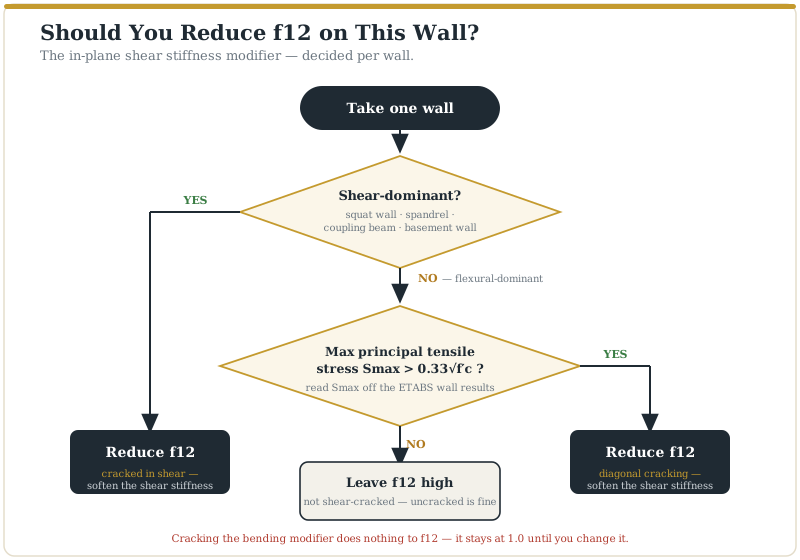
CSI's own guidance acknowledges this directly: many engineers modify only the flexural terms, while those who want realistic behaviour also reduce f12 where shear stiffness deteriorates. The default habit is to leave it. The correct habit is to ask whether this particular wall needs it reduced.
When the wall is shear-dominant, f12 matters most
The walls where leaving f12 at 1.0 hurts you are the ones where shear deformation is a meaningful part of the response — shear-dominant elements:
- Squat walls — low height-to-length ratio. Shear deformation dominates over flexure, so the shear stiffness is governing the wall's real behaviour, and an uncracked f12 badly over-stiffens it.
- Spandrels and coupling beams — short, deep elements spanning between piers. These work largely in shear, crack in shear early, and their stiffness drives how much coupling the system actually develops.
- Basement and retaining walls — deep, stiff elements where in-plane shear is a primary action.
For these, an uncracked shear stiffness tells the model the wall is far stiffer in shear than the cracked reality. The wall then attracts more lateral force than it truly would, because force follows stiffness — and you've made it artificially stiff.
When the wall is flexural-dominant — check before you reduce
How to decide whether to reduce it
For slender, flexural-dominant walls, shear cracking isn't automatic. The wall may well remain uncracked in shear even as it cracks in bending, so blanket-reducing f12 there would be wrong in the other direction — needlessly softening a wall that hasn't shear-cracked.
The way to decide is the principal stress check. Diagonal (shear) cracking initiates when the principal tensile stress in the wall reaches the concrete's diagonal cracking threshold — in practice, checking the maximum principal tensile stress, Smax, against roughly 0.33√f'c. If Smax stays below that, the wall hasn't shear-cracked and f12 can stay high. If it exceeds it, diagonal cracking is occurring and the shear stiffness should be reduced to match. ETABS reports principal stresses for the wall, so this isn't a hand calc — it's reading a result you already have and acting on it.
This is the honest version of the decision: shear-dominant walls almost always warrant a reduced f12; flexural-dominant walls warrant a check, and a reduction only if the principal stress says they've cracked.
The risk of leaving it at 1.0
This is why it matters rather than being pedantic. An over-stiff wall is a non-conservative error, and it's non-conservative in a way that hides:
- It attracts more lateral load than it should. Force distributes by relative stiffness. A wall left artificially stiff in shear pulls demand toward itself and away from other elements — so your force distribution across the lateral system is wrong everywhere, not just at that wall.
- You then under-design the elements it stole load from. The walls and frames that should have carried more are now modelled as carrying less. The error propagates silently through the whole system.
- Drift is under-predicted. A wall that's stiffer in the model than in reality makes the building look stiffer than it is. Your drift results are optimistic — exactly the wrong direction for a serviceability check that often governs tall buildings.
None of these throw a warning. The model is internally consistent and completely wrong about how the real building shares load, because you told it a cracked wall still has its full shear stiffness.
What this means in practice
The discipline is simple once you separate the two ideas. Cracking a wall is not one action — it's a flexural decision (the bending modifier, f22 or f11) and a shear decision (f12), and they're independent.
For every wall, ask: is this shear-dominant? Squat walls, spandrels, coupling beams, and basement walls — reduce f12, more or less by default. Flexural-dominant slender walls — check the principal tensile stress against the diagonal cracking threshold and reduce only if it's exceeded. And never assume that dialling down the bending modifier did anything at all to the shear stiffness. It didn't. f12 is still sitting at 1.0 until you change it, and on the wrong wall that's a non-conservative error you'll never see in the output.
The above reflects general modelling principles and is provided for educational purposes; modelling decisions on any specific project remain a matter of engineering judgement against the relevant standards.