Ask a room of engineers which element in a tall building gets treated worst, and the coupling beam has a strong claim. It's small, it sits in the worst possible place for the architecture, it's a nightmare to reinforce, and it carries enormous demand for its size. So it gets squeezed, simplified, and assigned whatever stiffness makes the numbers work. That last habit is where the real damage happens, because the coupling beam is not a minor connecting member. It's the element that governs how the entire coupled-wall system behaves.
If you work on core-wall towers, this is worth getting right, because almost every lateral result downstream depends on it.
What the coupling beam actually does
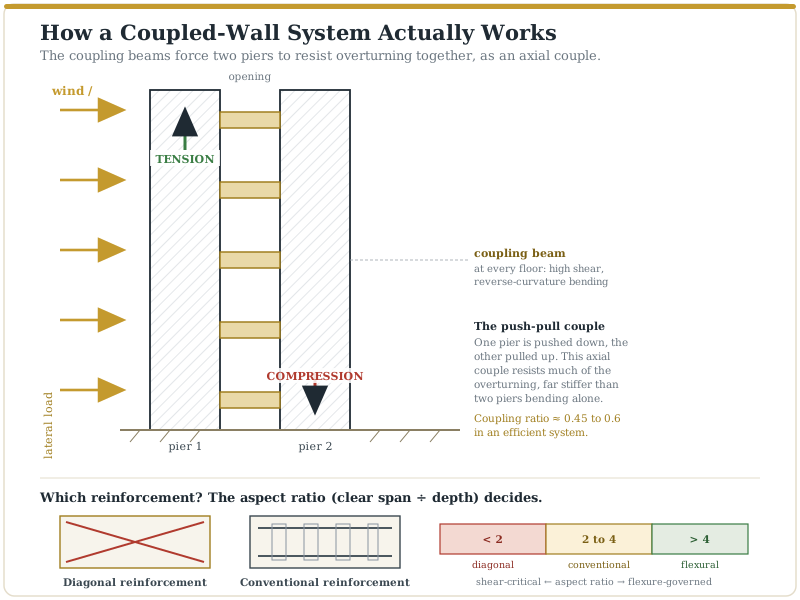
Put two shear walls either side of an opening, a lift core, a corridor, a row of windows, and connect them across that opening with a beam at every floor. Under lateral load the two wall piers want to bend independently. The coupling beams fight that, forcing the piers to work together. The beams go into high shear and reverse-curvature bending, and in doing so they transfer a vertical shear couple between the piers.
That coupling action is powerful. A well-coupled pair of walls behaves far stiffer than two isolated walls, because much of the overturning is now resisted by an axial push-pull couple across the two piers rather than by each pier bending alone. The share of total overturning carried by that couple is the coupling ratio, and in an efficient system it typically sits around 0.45 to 0.6.
Here's the part people underrate: how much coupling you actually get is set by the stiffness of the coupling beams. Stiff beams couple the walls hard. Soft beams barely couple them at all. The beams are small relative to the piers, so their stiffness is easy to get wrong, and getting it wrong changes the behaviour of the whole system, not just the beams.
The stiffness trap
This is the most common abuse, and it's worth being blunt. Coupling beams attract very high shear for their size, and the nominal shear stress frequently pushes against the code cap, the familiar limit from the √f'c family that exists to prevent web crushing. When a beam fails that check, there are two honest responses: change the beam, or accept the demand and detail for it. There's also a dishonest one that's extremely common: quietly soften the beam in the model until the demand drops below the limit.
It works, in the narrow sense that the number now passes. It also corrupts everything. Softening the beam reduces the coupling, which reduces the beam shear, which is exactly why the check now passes. But that same softening has told the model the walls are barely coupled. The load the coupling action should have carried gets redistributed back into the piers and down to the foundation in a completely different pattern. Your pier moments are wrong, your foundation demands are wrong, your drift is wrong, and your period has shifted. You didn't solve the shear problem. You hid it by lying to the model about how the building works.
The correct discipline is the opposite. Decide the coupling you want, model the beam stiffness honestly to deliver it, and if the beam then overstresses, that's real information telling you it needs different detailing or different proportions. The stiffness is an input you own, not a dial to turn until the output behaves.
Cracked stiffness is not optional
Even engineers who don't game the stiffness often leave coupling beams too stiff by using uncracked properties. Coupling beams crack early and hard. They're among the first elements to yield in a seismic event, by design, because they're the intended energy-dissipating fuses of the system. An uncracked coupling beam in your elastic model isn't representing the real element. Its effective stiffness is a fraction of the gross value, and the reduction is more severe than for most members because the beam works so heavily in shear. Different beam types warrant different reductions, so there's no single magic number, but gross stiffness on a coupling beam is simply wrong.
Diagonal or conventional: the aspect ratio decides
The reinforcement layout is the other place coupling beams go wrong, and the governing parameter is the aspect ratio, clear span divided by depth.
Short, deep beams with a low aspect ratio, roughly below 2, are shear-dominated. Conventional horizontal-and-stirrup detailing performs poorly here under cyclic load, a fact Paulay established by testing back in the 1960s. The failure is a brittle sliding shear failure at the face of the wall, exactly what you don't want in the element you're relying on to dissipate energy. For these beams, diagonal reinforcement is the answer: two groups of diagonal bars carry the shear as a truss, provide the moment capacity through the same members, and deliver the ductile, stable hysteresis the coupled system needs. Diagonally reinforced beams offer substantially greater ductility than conventional ones, which is why they're standard for low-aspect-ratio beams in regions of meaningful seismic hazard.
As the aspect ratio climbs, the picture changes. Longer beams become flexure-dominated, conventional detailing regains its validity, and above an aspect ratio of about 4 the beam behaves as a normal flexural member and is detailed as one. The mistake is applying one habit across the board. Work out the aspect ratio, check the nominal shear stress against the cap, and let those two together tell you whether the beam is shear-critical and needs diagonals, or flexure-governed and doesn't.
What this means in practice
Treat the coupling beam as a primary element, because it is one. Set its stiffness to deliver the coupling you actually want, and never soften it just to pass a shear check. Use cracked stiffness, because these beams crack early and gross properties over-couple the system. Choose the reinforcement from the aspect ratio and the shear stress. And remember that whatever stiffness you give the beam is a statement about how the building resists load, not a free variable to tune until the output looks agreeable.
The coupling beam is small, awkward, and in the way. It's also running your lateral system. The engineers who treat it as an afterthought are the ones whose coupled-wall behaviour never quite matches their model, and they usually never find out why.
The above reflects general design and modelling principles for educational purposes; decisions on any specific project remain a matter of engineering judgement against the relevant standards.