For years, a chunk of how engineering work got won had nothing to do with engineering. It was the polish: the well-written capability statement, the tidy methodology section, the proposal that looked like it came from a firm that knew what it was doing. That polish was a proxy. Clients couldn't easily judge the engineering, so they judged the presentation of it.
AI just removed that proxy. Anyone can now generate a fluent capability statement, a structured methodology, and a confident proposal in minutes. When everyone's documents look professional, looking professional stops being a signal. The question is what replaces it — and the answer is interesting for smaller and specialist players.
The polished proposal is now worthless as a signal
A capability statement used to carry information: it took effort and competence to produce, so a good one suggested a capable firm. That link is broken. The effort is gone, so the signal is gone. A solo operator and a hundred-person firm can now produce equally slick documents, which means the document tells the client nothing about which one to hire.
This is uncomfortable for firms whose edge was partly presentational, and it's quietly good news for engineers whose edge is actual depth. When the surface layer commoditises, buyers are forced to look past it — and what they look at next is harder to fake.
What AI can't commoditise
Strip away the polish and a few things are left standing, all of them harder for a tool to manufacture:
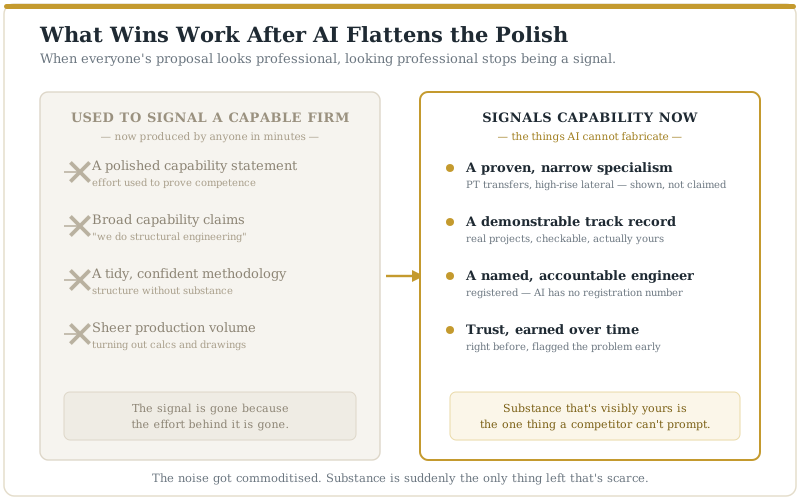
Specific, demonstrable expertise. "We do structural engineering" is now worthless as a claim — AI writes that sentence for anyone. "We do post-tensioned transfer structures and high-rise lateral systems, here's the analysis on three of them" is not something a tool can fabricate for a firm that hasn't done the work. The narrower and more provable the specialism, the more it survives the commoditisation of the generic claim.
Track record and judgement that's actually yours. Real project history, the war stories, the specific problems solved — these are evidence AI can't generate because they didn't happen to the firm pretending to them. The more your reputation rests on demonstrable, checkable work, the less AI-generated polish from competitors threatens you.
Accountability and registration. As mandatory registration spreads across Australia — Queensland long-standing, Victoria, the ACT, and Western Australia's building engineer scheme phasing in through 2026 and 2027 — the registered, accountable individual behind the work becomes the unit clients actually buy. You're not buying a document; you're buying a named person who can stand behind the result. AI doesn't have a registration number.
Trust, built through relationship and consistency. The thing AI most struggles to touch. Clients return to engineers who were right, who flagged the problem before it became expensive, who picked up the phone. None of that is in a proposal, and none of it can be prompted into existence.
Why this favours the specialist
Put those together and the shift works against the firm whose advantage was scale and presentation, and for the engineer whose advantage is specific, deep, demonstrable capability.
If you're a specialist, the move is to stop competing on the things AI has flattened — generic proposals, broad capability claims, production volume — and compete hard on the things it hasn't: a sharply defined niche, public proof of depth, a named accountable person, and a reputation that checks out. The polished generalist pitch is now background noise. A genuine, evidenced specialism cuts straight through it.
This is also why publishing real technical thinking matters more now than it did. When anyone can generate a capability statement, the way you prove capability is to demonstrate it in the open — to show the judgement, not assert it. Substance that's visibly yours is the one thing a competitor's AI can't replicate, because it would have to actually know what you know.
What this means in practice
The capability statement isn't literally dead — you still need one. It's dead as a differentiator. It's table stakes now: necessary, and worth nothing on its own, because everyone has a good one.
What wins work in an AI era is the opposite of what AI is good at: narrow proven expertise instead of broad claims, demonstrable track record instead of polished assertions, a named accountable engineer instead of a faceless firm, and trust that was earned rather than written. For specialists, that's not a threat. It's the best competitive environment they've had in years — the noise just got commoditised, and substance is suddenly the only thing left that's scarce.