AI can now produce a structural calculation, a design report, and a plausible justification in the time it takes to read the brief. The output is fluent, formatted, and confident. The question Australian practice hasn't fully reckoned with is simple: when an AI writes the work, who is accountable for it?
The answer, legally and professionally, is unchanged — and it's about to be enforced more tightly than ever. A registered engineer owns the work. The tool that drafted it owns nothing.
Registration is tightening, not loosening
The timing matters, because Australia is in the middle of the largest expansion of mandatory engineer registration in its history, and it's happening right as AI tools land in everyday practice.
Queensland has required registration (RPEQ) for decades — anyone providing a professional engineering service in or for Queensland must be a registered natural person, and unregistered practice is an offence. Victoria's scheme runs under the Professional Engineers Registration Act. The ACT made registration mandatory from March 2025. NSW requires it for building work. And in Western Australia, structural and fire safety engineers face mandatory registration from 1 July 2026, with civil and mechanical following in 2027 — practising in a prescribed area without registration after those dates is an offence carrying a fine.
The throughline across all of these schemes is accountability vested in a person. RPEQ registration, for example, can only be held by a natural person — not a company, and certainly not a tool. The entire regulatory direction is toward making it clearer, not fuzzier, exactly which qualified human stands behind a piece of engineering work.
The accountability doesn't transfer to the tool
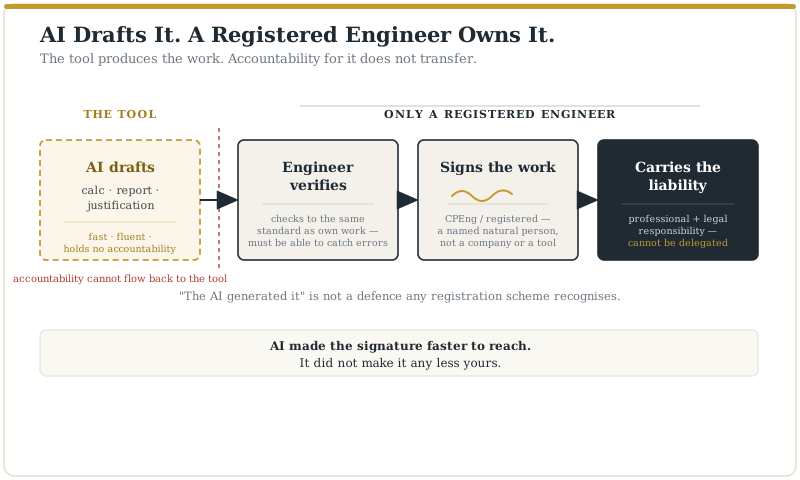
This is where AI-drafted work runs into the regime. You can hand a calculation to an AI. You cannot hand it the responsibility.
When a registered engineer puts their name to a design, they're asserting that it's been carried out competently and that they stand behind it — professionally, and under the relevant registration act. That assertion doesn't get weaker because a tool produced the first draft. If anything, it gets heavier, because the engineer now has to vouch for work they didn't generate line by line.
AI output is particularly demanding here precisely because it's fluent. A confident, well-formatted report reads as if it's been checked. It can contain a wrong assumption, a misapplied clause, or a load case that doesn't match the building, and present all of it with the same polish as the correct parts. The registered engineer is accountable for the wrong parts exactly as much as the right ones. "The AI generated it" is not a defence the registration acts recognise, and it's not one a board hearing would entertain.
What this means for how you actually work
The practical implication isn't "don't use AI." It's that the verification burden moves to the centre of the job, and it has to be real.
If you sign off on AI-drafted work, you are certifying that you have checked it to the same standard you'd apply to your own — which means you need the competence to catch what it got wrong, and you need to actually exercise that competence rather than rubber-stamp fluent output. The engineer who can't independently verify the AI's calc has no business signing it, registration or not. The engineer who can, and does, is using the tool correctly: as a fast first-drafter under genuine human review.
There's a second-order issue worth naming for firms. As registration spreads, the registered engineer's name on the work is the unit of accountability and the thing of value. A practice that lets AI volume outrun its capacity to properly review is accumulating risk against the names of its registered people. The tool scales production cheaply; it does not scale accountability at all.
Where this leaves us
Australian practice isn't unready for AI because the technology is too advanced. It's unready because the convenient assumption — that a fast, fluent draft is most of the work — collides with a registration regime built on personal, verifiable accountability. The faster AI gets at producing, the more the bottleneck and the value shift to the registered engineer who can stand behind the result.
So use the tools. They're good, and they're not going away. But the signature still means what it always meant: a competent, registered human has checked this and owns it. AI made that signature faster to get to. It did not make it any less yours.